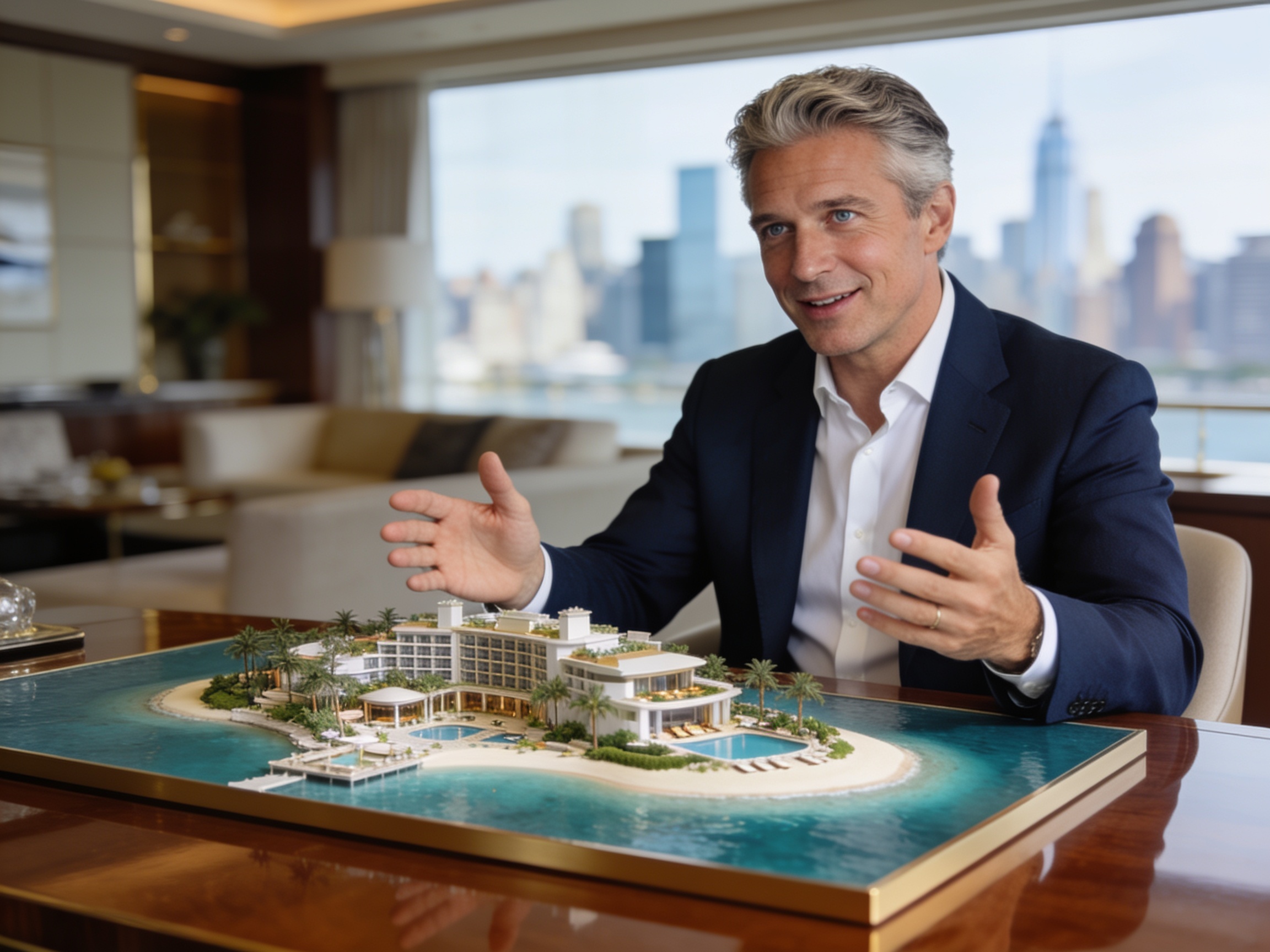
Meticulous planning of private resort developments illustrates the complex logistics behind exclusive jetset lifestyle access.
Top Ten Things – The global private aviation sector witnessed a 14% surge in flight departures in 2023, marking a definitive shift in how the ultra-wealthy perceive mobility. This statistic is not merely about travel preference, it signals the emergence of a hidden economy where money is no longer the primary currency. Access, timing, and absolute discretion have become the new benchmarks of status among the global elite.
While the public often equates luxury with tangible assets like supercars or designer watches, the true jetset economy operates on an entirely different frequency. We are witnessing a transition from conspicuous consumption to inconspicuous consumption. The focus has shifted from displaying wealth to buying back time and ensuring absolute privacy. This economy is built on layers of exclusivity that are invisible to the average consumer but dictate the daily lives of billionaires.
Consider the logistics of a simple dinner reservation. For the average person, it involves a phone call or an app booking. For an UHNW individual, it involves a ‘fixer’ who bypasses the host stand entirely, securing a private room that is not even listed on the restaurant’s floor plan. This layer of service is so seamless that the recipient often forgets it is a service at all. It simply becomes the standard of living.
Ownership is increasingly viewed as a burden by the new guard of wealthy individuals. Maintenance, staffing, and depreciation of assets like mega-yachts or vacation homes are seen as inefficient. Instead, the trend leans toward on-demand access to these assets without the administrative headache. Fractional ownership models and concierge apps that offer instant access to private islands or submarines are proliferating. This allows for variety and flexibility, two traits highly prized in a fast-paced global environment.
At the heart of this exclusive jetset lifestyle access lies the 24-hour concierge service. However, these are not the hotel concierges who recommend tourist spots. These are high-level logistics experts capable of chartering flights at 3 AM or securing last-minute visas to politically unstable regions. During our investigation into the operational standards of top-tier firms, we found that response times are often measured in seconds, not minutes.
These services maintain deep databases of contacts, ranging from private security contractors in conflict zones to the personal sommeliers of exclusive wineries. When a client requests a specific vintage of wine, the concierge does not just check inventory, they leverage relationships to source it directly from the collector. The value proposition here is not just obtaining the item, but obtaining it with zero friction.
A rapidly growing facet of the concierge economy is medical biohacking. Wealthy individuals are no longer content with standard healthcare; they want predictive and preventative optimization. Services now include flying in specialists from top institutes for weekend house calls or arranging stem cell therapies in countries with progressive regulations. We observed case studies where executives underwent comprehensive genetic sequencing and blood analysis to create personalized supplement regimes delivered daily to their doorsteps.
Read More: Jetsetters Lifestyle
The cost of entry into this tier of lifestyle is staggering, yet the demand remains inelastic. Membership fees for elite clubs like Knightsbridge Circle start around $25,000 annually, but the real threshold is the vetting process. Candidates are often rejected for lacking the ‘social fit’ or the requisite network, proving that money alone cannot open every door. This exclusivity creates a sense of scarcity that drives demand even higher among those who are used to getting what they want.
Data from the Luxury Institute indicates that high-net-worth individuals spend approximately $150,000 per year on experiential luxury services alone. This excludes hard assets. This spending is heavily concentrated on time-saving mechanisms and health preservation. The rationale is straightforward: time is the only asset that cannot be replenished. Therefore, any service that recovers time is infinitely valuable, regardless of the price tag attached to it.
Read Also: The Wealthiest Billionaires And Their Global Empire Secrets
Read More: Ultra Wealthy Private Jet Lifestyle Secrets Revealed
While this lifestyle promises freedom, it often delivers a gilded cage. The pursuit of total privacy can lead to extreme isolation. When you travel exclusively via private terminals, stay in private villas, and dine in private rooms, you effectively remove yourself from the public sphere. This disconnect can create a distorted reality where the struggles of the average person become abstract concepts rather than lived experiences. It is a psychological side effect rarely discussed in glossy lifestyle magazines.
Furthermore, the security apparatus required to maintain this lifestyle is intrusive. Close protection teams, cyber-security sweeps of hotel rooms, and armored transport are standard fare. Living under this constant surveillance creates a low-level background tension. The freedom to go anywhere is paradoxically restricted by the protocols required to keep you safe while going there. This is the trade-off of exclusive jetset lifestyle access.
Read More: Beyond the Flight
To navigate this world, one must understand the unwritten rules of engagement. It is not enough to flash a black card. Relationships must be cultivated with gatekeepers. Whether it is the head of reservations at a hotel or the manager of a private jet terminal, these individuals hold the keys to the kingdom. Treating them with respect and recognizing their expertise yields far better results than arrogance.
Let us look at a concrete scenario: securing a table at a fully booked, no-reservations venue like a specific omakase counter in Tokyo. The brute force method of offering money often fails. The effective strategy involves utilizing a networked concierge who has a pre-existing relationship with the chef. By positioning the request as a culinary enthusiast rather than a rich tourist, the dynamic changes. The narrative shifts from ‘I want to buy this’ to ‘I want to appreciate this art form’, which appeals to the vanity of the creator.
Another actionable area is health optimization. Rather than waiting for illness, individuals in this sphere proactively manage their biology. This involves coordinating a team of specialists, from nutritionists to sleep coaches. Implementing a tiered health strategy, starting with advanced diagnostics and moving to bio-feedback devices, allows for data-driven health decisions. It transforms the body from a vessel that carries you into a project that is continuously being upgraded for performance.
While some tiers accept members with $5 million in liquid assets, the true ‘white glove’ services generally require a net worth exceeding $50 million or significant social influence.
They rely on long-term reciprocal relationships and networks. They trade favors and access rather than simply paying premiums, leveraging their reputation to open doors that money cannot.
Yes, primarily because it eliminates wait times and utilizes smaller airports closer to the final destination. However, it also allows for working en route without interruption, effectively creating billable hours that would otherwise be lost.
The biggest misconception is that it is purely about relaxation. In reality, it is often more stressful due to high-stakes decision-making and the logistical complexity of managing assets across multiple time zones.
While AI can manage bookings and data, it cannot replicate the nuance of crisis management or the emotional intelligence required to handle delicate personal situations. The human element remains the premium value proposition.
The landscape of luxury is evolving into a complex ecosystem of access and privilege. Understanding the mechanics behind exclusive jetset lifestyle access reveals that for the ultra-wealthy, convenience is the ultimate commodity. As this sector grows, the gap between the service economy and the serviced economy will only widen. The question remains: at what point does the pursuit of a frictionless life begin to erode the very experiences it seeks to enhance?
Top Ten Things - The global fascination with high‑performance vehicles has surged, with 2023 sales of luxury sports cars hitting…
Top Ten Things - A recent survey by GlobalWebInsights 2024 reveals that 68% of net users admit mimicking at least…
Top Ten Things - The global entertainment sector generated over $2.5 trillion in 2023, fundamentally rewriting how consumers eat, dress,…
Top Ten Things - Recent financial audits reveal a disturbing trend in modern consumer behavior where the average individual loses…
Top Ten Things - The average person now spends approximately 4 hours and 37 minutes daily staring at mobile screens,…
Top Ten Things - A comprehensive review of global conservation data indicates that while eco-friendly living is trending, the measurable…